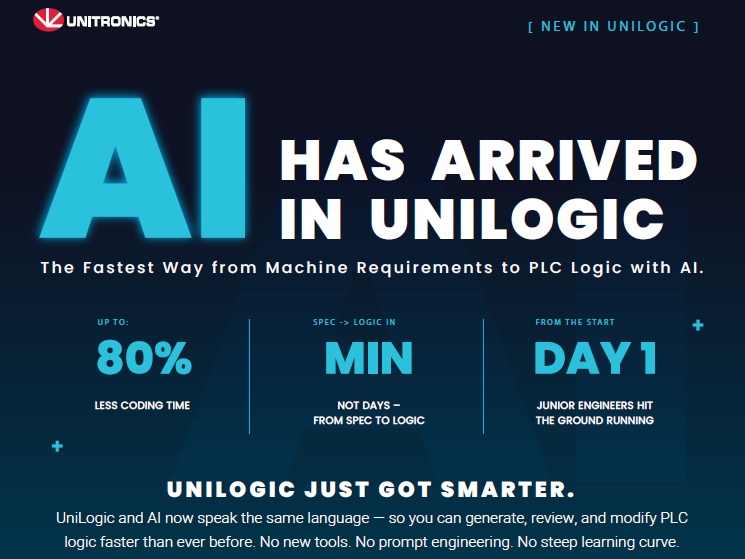
Unitronics’ new built-in AI turns control requirements into working PLC logic — without asking engineers to become AI experts, and it actually delivers.
For engineers designing control systems, whether for a manufacturing line, a critical building plant room, or a data centre cooling application, one challenge has remained largely unchanged for decades: converting functional requirements into reliable control logic. Every sequence, interlock, alarm condition, and operating mode must be translated into code, line by line.
The process is labour-intensive, demands platform-specific expertise, and often represents the biggest barrier for new engineers entering the industry. Even experienced programmers spend countless hours crafting logic that, while necessary, adds little engineering value. Time spent writing routine code is time not spent commissioning systems, solving operational problems, or delivering the next project.
AI seems like the obvious solution, until engineers try using it..
Ask a general-purpose AI model to generate PLC logic and the results can be inconsistent. The output may be overly generic, fail to follow platform conventions, or simply be unsuitable for the target controller. The problem is rarely the AI itself. More often than not, success depends on the quality of the prompt.
Obtaining useful results requires detailed technical instructions, correct terminology, structured requirements, and an understanding of how AI systems interpret requests. In other words, engineers must become prompt engineers before they can benefit from AI, introducing a new learning curve to solve an existing one.
Recognising this challenge, Unitronics has taken a different approach
Unitronics — whose UniStream PLC and HMI controllers show up everywhere from production machinery to building automation panels and data centre cooling systems — built its newest capability around that exact gap. Rather than opening a blank AI chat and hoping for the best, engineers using UniLogic now answer a short set of guided questions about their application: what it does, how it’s controlled, what I/O is involved.
The software then combines those responses with information already available within the project, automatically building a comprehensive, structured prompt that can be used with the engineer’s preferred AI platform.
This is not an AI chatbot inside the software. It’s the intelligence that happens before the AI.
That distinction is important.
UniLogic does not attempt to replace ChatGPT, Claude, Gemini, or any other AI platform. Instead, it solves one of the biggest obstacles to successful AI-assisted programming: knowing how to communicate technical requirements clearly and completely.
Engineers remain free to work with the AI tools they already trust. The difference is that they are no longer forced to start from scratch, manually assembling detailed prompts or worrying about whether critical information has been omitted.
The result is a workflow that makes AI more practical, more predictable, and significantly more accessible for everyday engineering tasks.
Three key benefits for engineers
- Faster project delivery. Unitronics reports programming time reductions of up to 80%. Tasks that previously required days of coding and refinement can now move from functional requirements to usable logic in minutes, accelerating project schedules without compromising engineering oversight.
- Simpler adoption of AI. Successful use of AI no longer depends on learning complex prompting techniques. Engineers simply describe the application they already understand, while project tags, I/O definitions, and existing system information are incorporated automatically. The workflow becomes an extension of normal engineering practice rather than an entirely new process.
- Reduced dependence on individual experience. New engineers can begin producing code that aligns with established platform standards from the outset, dramatically shortening the journey from trainee to productive contributor. At the same time, experienced teams gain greater consistency across projects, helping systems integrators and controls contractors standardise their programming approaches.
Engineers remain in control
What this technology does not change is accountability.
AI-generated logic still requires review, testing, validation, and verification before deployment. Safety functions, operational edge cases, commissioning decisions, and system performance remain the responsibility of qualified engineers.
What changes is how engineering time is allocated. Less effort is spent creating an initial draft of routine logic, while more time can be devoted to areas where human expertise delivers the greatest value: system design, troubleshooting, optimisation, and risk management.
In many ways, this reflects the broader direction of the controls and building automation industries. The conversation around AI is increasingly moving away from replacing engineers and toward removing low-value friction from the engineering process. Organisations are looking for ways to reduce reliance on individual experience, improve consistency, and help less experienced staff contribute meaningful work more quickly.

Unitronics’ latest UniLogic capability addresses that challenge directly.
The message is simple: engineers should not need to become prompt engineers to benefit from AI. By transforming engineering requirements into structured, AI-ready instructions, UniLogic makes advanced AI tools more accessible, more effective, and far easier to integrate into real-world PLC development workflows.
The capability is available today within UniLogic, with a free trial of the full platform available for engineers who want to experience the workflow first-hand.